Showing posts with label Feminism. Show all posts

Wednesday, May 7, 2008

Women in the New Doctor Who

(small spoilers ahead)

There's a lot that can be said about the old Doctor Who(s): cheesy story lines, silly special effects, barely-scary baddies... and give me a few hours and I'll say way too much about it. For now I just want to talk about the misogyny, which is unmissable. The Doctor is a cheeky cocksure playboy who is more than a little dismissive towards his female companions, most of whom fit an insulting stereotype: the girl-next-door, the harpy... and all of them eye-candy.


I should point out that this makes the old Doctor Who(s) absolutely indistinguishable from 99% of the programming that's ever been produced.

The new Doctor Who is a miracle of progressive story telling. Setting aside the fact that most of the stories are really well put together, creative, funny, intense, clever, etc., the new series routinely casts multicultural characters and biracial couples, uses strong women as central characters, and when it comes to sexual politics, well, we're talking about the series that brought us the miracle of Captain Jack Harkness, the Omnisexual hotpot from the 51st Century.


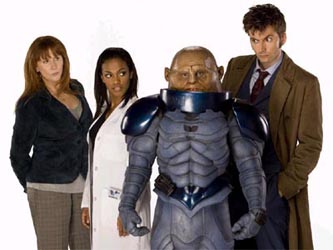
This series has given us a series of three (so far) female companions: Rose Tyler (played by Billie Piper), Dr. Martha Jones (Freema Agyeman), and Donna Noble (Catherine Tate).


Rose Tyler is amazing. She's a streetwise kid who grew up in the London projects. In the first episode she saves the Doctor's life -- and Earth -- with cleverness, heroics, and strength. And she only gets more awesome from there. She is the Doctor's match in every way. When she's lost (to another dimension) at the end of the (completely riveting and intense) second season, the Doctor (quite forlorn) returns to his TARDIS to discover a big loud red-headed human named Donna -- more on her in a second. The big knock against Rose Tyler? She's too good to be true.


Martha Jones is a medical doctor. She's brilliant, gorgeous, and, given time, she also saves all humanity. The big knock against this character (from my point of view) is that she has a crush on the Doctor. She leaves after a season because she's sick of making a fool of herself over him. The good news is that once she leaves the Doctor she uses her skills and knowledge to have this awesome alien-fighting career on Earth, becoming a recurring character in both Doctor Who and Torchwood (where Captain Jack makes Sexy out of Cardiff Good and Long).


And then there's Donna. (I said I'd come back to this.) Donna Noble is, without a doubt, my favorite fictional character, ever ever ever. She's not young. She's not skinny. She's not clever. She's not brave. She's not likely to save the world. She has no romantic interest in the doctor at all. What is she? She's a real, complex, very funny, tricky, tough, totally human person. And let me tell you (if you haven't noticed): such characters, in the female variety, are very hard to come by, rare as 12 lb diamonds.

In the first episode of the new series, which is also the first episode with Rose, Rose swings down to save the day (surrounded by aliens and danger), showing superhuman courage, strength, and cleverness. In The Runaway Bride, Catherine Tate (as Donna) parodies this moment with classic comedy timing -- and falls flat on her face. In every way that Rose is too perfect, Donna is perfectly human and flawed.

In the first episode of the third season, the Doctor kisses Martha so she'll have alien DNA on her and distract some intergalactic stormtroopers. From that moment Martha crushes madly on the Doctor, and their entire relationship is defined by her googly-ness for him. Fair enough. But then there's Donna: when the Doctor tells Donna that he just wants a mate, she says, "you just want to mate?! You're not mating with me, alien boy!" They're buddies, often in conflict with one another -- passing for brother and sister when they visit ancient Pompeii (he goes by Spartacus -- and so does she).

It's a kind of relationship -- a non-sexual friendship between an man and a woman -- that is very real, and very important, but not one that gets portrayed much in fiction. Or if it is, one of them is probably gay, or both of them are pre-adolescents. But here are two adults -- 40 and 903 -- from different planets, and different sexes -- and why are they traveling the universe in a blue box? Is it to wind out some sexual tension? No: it's because they want to have fun, skirt danger, and free some enslaved races. Awesome.


Of course it's easy to miss this. While I've been lapping up these story elements with a "where have you been all my life" sense of glee, Brian didn't notice (or didn't believe?) that Donna wasn't a sex interest in the story. You know what? I can understand that. We've all be so brainwashed by the stories we see to believe that women are there for one thing ... who can blame a man for not noticing that she's not? We actually got into a bit of a scuffle when he made an offhand comment about how if all three companions got together (and they will, at the end of this season), they would fight. Why would they fight? It's an absurd suggestion. Yet it's what we automatically assume will happen in a story because so many stories have come before and played out that exact scenario -- which is nothing more than an ego-feeding male fantasy.

The writers of Doctor Who brilliantly lampooned this in the 4th episode of the season, when Martha and Donna meet. He admonishes them to "don't fight!" to which Martha replies "you wish," and she and Donna go on to be fast friends.

It is, in short, the best shit on TV. If you're not watching Doctor Who, you're missing out on the sharpest humor/social and political commentary out there today. The first episode of season 4 (which features the wonderfully not-slim Catherine Tate) is about an alien species using our obsession with losing fat as a sick (and hilarious) way to propagate their species (hint: the company's slogan is "the fat just walks away!") -- the most recent two-part battle with the Sontarans turned our cars against us as weapons, to gas us to death. And the 3rd episode of the new season is about freeing a race (the Ood) from their "invisible" slavery. (They're enslaved by future humans, by the way.)


But the best thing, to my mind, about the new Doctor Who is how it has created this wonderful space for female characters to live and grow and save the world. And Catherine Tate's Donna Noble is the best character to appear in anything, ever ever ever.

Sunday, May 4, 2008

Feminism 2008

Feminism takes many forms. The picture on the left was published as a cover of Redbook. The picture on the right is the "raw picture" -- the pre-photoshop actual photo. It was purchased for $10,000 by a woman-run blog called Jezebel for the purpose of this side-by-side. Why? Because they've got a grudge against this Faith Hill lady? No. Because we've all been living in this world and looking at these images for so long, our brains have come to accept the image on the far left as normal. And it takes the image at near-left to remind us that the first one doesn't even look human, let alone normal. It's like having to be reminded that no one actually looks like anime or Disney "princesses." Our minds are warped and this unwarps them a little. And by the way, the woman in that unimproved picture? She is seriously pretty. Prettier than anyone I've bumped into in the last couple months. Why do we prefer looking at the alien creature on the left?

The New York Times has a piece about some of the latest advances being made in artificial intelligence. AI is important not just to creating the evil cylons that will turn into super-hot monotheistic cylons someday, but to making computers work better. We won't be able to just ask computers questions and get decent answers -- Star Trek style -- until those computers can think. So AI is important. And some of the most important work going is being done by a woman, Daphne Koller:

A mathematical theoretician, she has made contributions in areas like robotics and biology. Her biggest accomplishment — and at age 39, she is expected to make more — is creating a set of computational tools for artificial intelligence that can be used by scientists and engineers to do things like predict traffic jams, improve machine vision and understand the way cancer spreads.

Ms. Koller’s work, building on an 18th-century theorem about probability, has already had an important commercial impact, and her colleagues say that will grow in the coming decade. Her techniques have been used to improve computer vision systems and in understanding natural language, and in the future they are expected to lead to an improved generation of Web search.

“She’s on the bleeding edge of the leading edge,” said Gary Bradski, a machine vision researcher at Willow Garage, a robotics start-up firm in Menlo Park, Calif.

I'm actually kind of impressed that the author of this article did not find Ms. Koller's sex remarkable. At no point in this story does the article make any note at all of the fact that she is a woman working in a field that is usually regarded (stereotypically and stupidly) as "male."

Since arriving at Stanford as a professor in 1995, Ms. Koller has led a group of researchers who have reinvented the discipline of artificial intelligence. Pioneered during the 1960s, the field was originally dominated by efforts to build reasoning systems from logic and rules. Judea Pearl, a computer scientist at the University of California, Los Angeles, had a decade earlier advanced statistical techniques that relied on repeated measurements of real-world phenomena.

Called the Bayesian approach, it centers on a formula for updating the probabilities of events based on repeated observations. The Bayes rule, named for the 18th-century mathematician Thomas Bayes, describes how to transform a current assumption about an event into a revised, more accurate assumption after observing further evidence.

Ms. Koller has led research that has greatly increased the scope of existing Bayesian-related software. “When I started in the mid- to late 1980s, there was a sense that numbers didn’t belong in A.I.,” she said in a recent interview. “People didn’t think in numbers, so why should computers use numbers?”

Ms. Koller is beginning to apply her algorithms more generally to help scientists discern patterns in vast collections of data.

“The world is noisy and messy,” Ms. Koller said. “You need to deal with the noise and uncertainty.”

I love that she's more inclined towards numbers than most -- further putting the lie to the "girls can't do advanced math/science" canard. But again, I'm the one pointing this out; the article doesn't even notice she's a woman or that there's anything noteworthy about that. I think that's wonderful and very optimistic, but are we there yet? No, we're not there. So I hold up Daphne Koller as the feminist hero of the day. Hurray Ms. Koller! You are awesome.

Monday, October 8, 2007

Chick Flicks

Here's something every writer of fiction knows: if your protagonist is male, readers will probably follow him; if your protagonist is female, no guarantees, bitch.

[I can only imagine how this must affect you if you are a woman who writes non-fiction.]

I've seen this at work in my own stories: gender is rarely an issue in my stories, but being a woman, I often use a woman protagonist by default. Much to my bewilderment, my less wonderful stories are usually considered more interesting by others (especially men) when there's a guy at the center of the plot. And much better stories featuring women are (for some reason I am always told this) "about" strong women. [Instead of being about all the other things I'm writing about -- so what I'm to take from this is, if I use female characters, their very female-ness will suck all the air out of the story and no one will see anything but boobs? Are the stories with male protagonists "about" strong men? I mean, this is fiction, and not fiction where gender matters: I can switch the genders back and forth at will...?]

This phenomenon is apparent from a very young age: young boys and girls are equally willing to follow a story about a male puppet, male fish, male rat, male ant, male lion, et ceteri, but a lot of boys tune out when the protagonist is a chick.

I mentioned this to my fiction class on Friday in the course of a very lovely lecture about mirror neurons and empathy and the social good of stories that feature outcasts - people not accepted by their societies. If we read about and empathize with Paul from "Paul's Case," or Desiree from "Desiree's Baby," how can we dehumanize them and dismiss their plight? I mentioned that in the past boys have been resistant to stories featuring females and white audiences resistant to films featuring black actors, but that these are trends that are slowly changing for the better... and I think what I said is true...

But on Friday, the very day that I'm sowing these seeds of hope in the minds of impressionable youths, this series of tubes to which we are all so glued, the interwebs, lit up with word that Warner Bros. production president Jeff Robinov has decreed: NO MORE FILMS WITH FEMALE LEADS.

Now, I understand why he would come to this conclusion. As I told my students: book publishers and movie-makers know that stories featuring white male protagonists will be accepted by almost everyone, while stories starring (for example) black females will be "rejected" by very many (especially white males): the profit motive discourages change.

So I understand your plight, Mr. Robinov. The profit motive tells you exactly what kind of movies to make: shiny big blow-ups with bouncing boobs one of whom is a famous tough-guy male actor who kills the bad guy, gets the girl, and saves the day, if not the world, hooray. So you just keep on making that movie. You make it and make it and make it and make it. And see how well at the box office you do. We'll talk reason with the person they hire to replace you. [Yeah, that might be a while...]